AI Face Aging - Photo Editor
- 4.0
- Rating
- 5.00M
- Installs
- Free
- Price

 Analysis by App-foxy
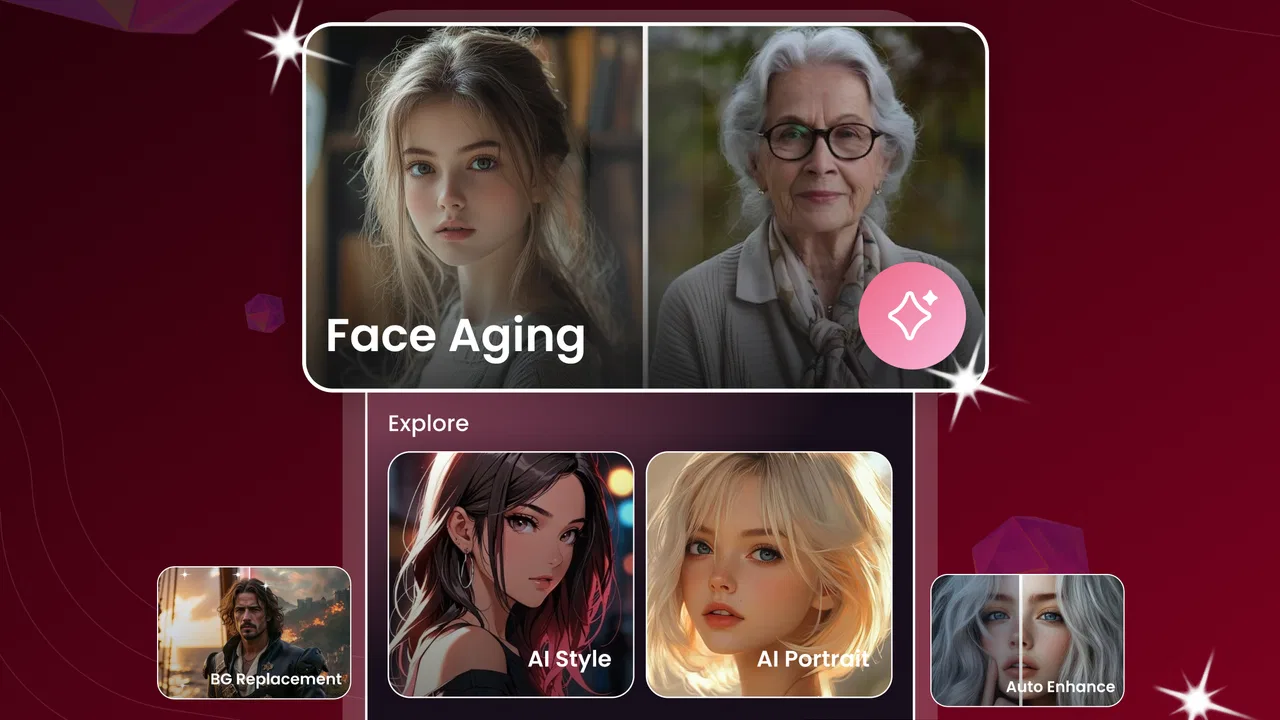
Some photo-editing ideas are all about getting a quick laugh or satisfying a little curiosity: what might I look like years from now? AI Face Aging - Photo Editor is a photography app built around that theme, with a store summary that also mentions face swapping. Its pitch is simple—an AI-focused face-aging editor that aims to make the process feel quick. I’d approach it as a casual creative tool rather than a full photo-editing suite, especially if the main appeal is seeing a playful aging effect on a picture.
What to expect from a quick edit
The app’s short description, “AI Face Aging,” keeps expectations focused on one central idea. That’s useful if you’re browsing for a way to experiment with an age-transformed portrait without first learning a complicated editor. The summary’s reference to face swaps adds another hint of playful photo manipulation, though the app’s core identity remains face aging.
Speed is part of the appeal implied by the phrase “in seconds,” but that should be treated as a promise of a quick workflow, not a guarantee that every image will process instantly. Results can depend on the photo, the phone, and the app’s processing demands. I’d expect the most satisfying experience to come from choosing a clear portrait and giving the editor a moment to work, rather than judging it by a stopwatch.
You May Also Like

 Blood Strike: 2.5 Anniversary
Blood Strike’s Loadouts Turn Every Drop Into a Tactical Gamble
A close look at Blood Strike’s custom loadouts: how fast access to signature weapons reshapes its battle royale rhythm, rewards preparation, and narrows the gap between fights.

 Pandora - Music & Podcasts
Pandora’s Music Is Easy to Start, but Harder to Recover
Pandora’s strength is its low-effort path from a seed to a station. Its weak spot is how much confidence it asks you to place in connection, setup, and quiet recovery.

 8 Ball Pool
 Is Built on Rivalries, Rematches, and Routine
A close look at the rivalries, rematches, shared routines, and unanswered safety questions that turn a quick pool match into a persistent mobile community.

 Samsung Music
’s Quiet Strength Is Playing What You Already Own
Its reach comes less from spectacle than from dependable access to a personal library. That simplicity is both the app’s strongest retention engine and its ceiling.

 AccuWeather: Weather Radar
AccuWeather Review: A Quick, Clear Forecast for Everyday Decisions
For everyday plans, the best forecast is the one you can understand quickly. AccuWeather makes rain timing, radar, and local conditions easy to act on, with a few trade-offs.

 Hill Climb Racing
Why Hill Climb Racing Still Turns Crashes Into One More Run
A tiny car, a bumpy hill and one more upgrade: Hill Climb Racing keeps resurfacing because its simple chaos makes every near-miss feel personal.
More From Our News Desk
View All News


That makes AI face aging an easy concept to understand: pick a face-focused image, try the transformation, and see whether the result matches the mood you had in mind. The attraction is less about precise retouching and more about curiosity and entertainment. If you want a practical editor for detailed color correction, cropping, or layered design, this narrow theme may not be enough on its own.
Why the lightweight idea matters
A focused app can be appealing because it gives newcomers a clear reason to open it. You don’t need to arrive with a photography plan or editing vocabulary; the premise is immediately recognizable. For a casual session, that simplicity can matter more than a long list of tools, especially when you just want to test a transformation and share the result elsewhere.
Still, “simple to understand” and “instant in every situation” aren’t the same thing. AI-style image effects may take longer with a less suitable photo or on a device that has limited available resources. I’d keep expectations flexible: a straightforward edit should feel approachable, while repeated experiments or demanding images may take more patience.
When you use it more heavily
The first try is only part of the experience. A more realistic test is what happens when you compare several portraits, repeat an effect, or spend a longer stretch experimenting. That kind of use can make processing waits more noticeable and can reveal whether the app feels comfortable as a quick novelty or something you’d return to for a longer creative session.
Because the app centers on face aging, the quality of the source image is likely to influence how enjoyable the result is. A well-lit, clearly framed face gives an image editor more visual information to work with than a distant or obscured subject. That is a general consideration for portrait effects, not a promise about a particular output. I’d try a few different pictures before deciding whether the style suits your photos.
It’s also worth separating an entertaining result from a realistic prediction. An age effect is a creative transformation, not a reliable forecast of how someone will actually look in the future. That distinction helps keep the app fun: treat the outcome as a visual gag or imaginative portrait, rather than as a statement about health, identity, or appearance.
Keeping a session comfortable
For occasional use, a small number of edits is likely to be the natural way to enjoy an app with such a focused concept. If you start processing images back to back, pay attention to how your own phone responds. Longer sessions can be more demanding than a single edit, and closing other apps or taking a pause may help if your device begins to feel sluggish. Those are ordinary mobile-use habits, not special requirements attributed to this editor.
For anyone deciding whether to install it, the practical question is less “Can it replace my main editor?” and more “Do I want a dedicated place to try an aging effect?” The answer depends on how often you enjoy playful portrait transformations. If that idea makes you curious, the focused premise is a good reason to give it a look; if you need a broad toolkit, a specialist effect app may feel limited.
Reliability and everyday use
The store summary emphasizes doing a face swap “without glitches,” which signals that smooth results are part of the product’s pitch. I’d read that as an aspiration rather than a universal guarantee. Photo effects can behave differently across images and devices, so reliability is best judged by trying the same general workflow on a few suitable portraits and seeing whether the app remains comfortable to use.
One successful result is encouraging, but consistency across multiple attempts matters more if you plan to use the app regularly. I’d look for a clear, repeatable editing flow and results that complete without making the experience feel frustrating. If a particular photo produces an awkward transformation, that doesn’t necessarily mean the app is broken; the image itself may simply be a poor match for the effect.
The app has an average rating of 4.0 from around six and a half thousand ratings, with about sixty reviews. Those figures offer a broad snapshot of how it is received, but they don’t tell you whether your preferred photos will produce the look you want. The most useful test remains personal: try the face-aging concept on an image you’re comfortable using and judge the result for yourself.
What a sensible reliability check looks like
I’d start with one uncomplicated portrait, then try another image with a different framing or lighting condition. That makes it easier to tell whether a result is a one-off or whether the editing experience generally suits your pictures. If you find a look you like, save or share it using whatever options the app provides on your device, while keeping your usual care around personal photos.
It’s also sensible not to confuse a temporary pause with a permanent problem. Mobile apps can take longer when a phone is busy, a connection is weak, or the image needs more work. If an edit seems stuck, waiting briefly and trying again later is a reasonable first step. I wouldn’t base a firm reliability verdict on a single slow attempt.
Device fit and practical expectations
The listed minimum operating-system requirement is Android 8.0, so users on older Android releases should check compatibility before planning to use it. That requirement is useful context, but it does not tell you how quickly the app will perform on every compatible phone. A device can meet a minimum software requirement and still feel different from a newer model during image processing.
The app is free, rated for Everyone, and has passed five million installs. Those details make it easy to understand its broad audience and reach, but they don’t establish that every phone will deliver the same speed or image quality. As with other photo tools, keeping your system reasonably up to date and leaving some storage and memory available can support a more comfortable experience.
It’s developed by Willson Studio and is currently at version 1.1.1. The app was released on February 3, 2026. That release information helps place the product in context, while the version number identifies the edition currently described. Neither detail alone is a performance benchmark, so I’d avoid assuming that a particular handset will process images at a specific pace.
On iOS, availability and requirements can vary by store and device, so check the relevant app store before installing. The Android minimum listed here is not a substitute for checking an Apple device’s compatibility. Either way, the best expectation is a casual portrait editor whose feel depends partly on the phone and photo you bring to it.
Is AI Face Aging worth trying?
AI Face Aging - Photo Editor is easiest to recommend to people who are curious about a playful portrait transformation and want a focused place to try it. Its appeal is clear without a long learning curve: the theme is recognizable, the app sits in photography, and the face-aging idea invites quick experimentation. The mention of face swapping broadens the playful mood, though I would keep the central expectation on aging effects.
For performance, I’d call it a “try it and see” app rather than promise a flawless instant result. The product’s own wording stresses speed and smoothness, while real-world feel can still depend on the image and device. One or two casual edits should be a fair way to decide whether the workflow feels responsive enough for you. If you expect to process many images in one sitting, give the phone room to work and judge the experience over a longer session.
Its sizeable install base and solid average rating suggest that plenty of people have been willing to give it a chance, but those signals are only part of the decision. What matters most is whether you enjoy the transformations and find the editing pace comfortable on your phone. I’d treat it as entertainment first, keep expectations realistic about generated appearances, and use a clear portrait for the best chance of a satisfying experiment.
Overall, this is a straightforward option for anyone searching for an AI face aging photo editor rather than a comprehensive studio in their pocket. If you want a quick visual novelty and don’t mind that processing may vary from one device or image to another, it has a clear reason to be on your shortlist. If your priority is extensive manual control or guaranteed instant processing, you may want a broader editing app instead. For a casual “what would this look like?” moment, though, its focused concept is the point.
FAQs for AI Face Aging - Photo Editor
01What does AI Face Aging - Photo Editor do?
AI Face Aging - Photo Editor uses facial photo effects to create an aged-looking version of a face. Depending on the tools available in the app, you may be able to choose an aging style, apply the effect, and save or share the result. The output is an entertainment edit, not a prediction of how someone will actually look in the future.
02How do I get a good result with AI Face Aging - Photo Editor?
Start with a clear, well-lit photo in which the face is visible and not covered by accessories, hair, or other people. A front-facing image generally gives a photo editor more facial detail to work with than a distant or heavily angled shot. Results can vary with photo quality and the app’s processing, so try another image if the effect looks incomplete or unnatural.
03Does AI Face Aging - Photo Editor require an internet connection?
Whether the app can process photos offline depends on how its aging effects are implemented and which features are available in your version. Some photo effects may work on the device, while AI processing or additional content may require a connection. Check the app’s current store listing and try its features with your connection disabled before relying on offline access.
04Is AI Face Aging - Photo Editor free to use?
The price and available features can vary by platform, region, and app version. The app may offer free editing alongside advertisements, in-app purchases, or a subscription for additional tools; confirm the current terms on its Google Play or App Store page before installing. Review any trial period and renewal details carefully so you know whether charges may apply.
05What should I know about photo privacy before using AI Face Aging - Photo Editor?
A face photo is personal information, so review the app’s privacy policy and requested permissions before uploading or editing images. Check whether photos are processed on your device or sent to a service, how long they may be retained, and whether they can be used to improve features. Only use images you have permission to edit, and avoid sharing sensitive photos.
Pros
- A simple interface makes age effects quick to apply.
- The preview helps compare the original and edited portrait.
- Works well for lighthearted photo transformations.
- Edited images can be shared with friends.
- Useful for creating playful portraits for social posts.
Cons
- Results can look artificial on some faces.
- Image quality may vary with lighting and photo clarity.
- Some features may require payment or a subscription.
- Processing may take longer on older devices.
- Uploading personal photos may raise privacy concerns.

AI Face Aging - Photo Editor
Gallery